TIMBER WALL CONSTRUCTION // HOLZWAND MODULBAU
T I M B E R W A L L C O N S T R U C T I O N
Due to the significant environmental problems associated with cement production and the extraction of construction sand, entirely new approaches could be taken in the construction sector. My approach: sustainable building components in an affordable modular design, ➡️multi-story, scalable, contributes to this.
The Timber Wall Construction is suitable for everything from tiny houses to multi-story buildings. The low module weight makes it ideal for adding stories to existing buildings. Thanks to its high inherent stability and dry construction method, cost-effective buildings can be erected quickly.
With proper installation, a very long service life can be expected. At the end of its lifespan, all building elements are sorted and ready for reuse. The concept is conceived as an open, evolving building system that represents a future-proof alternative to cement- and energy-intensive construction methods.
This modular plug-in system could generate secure profits everywhere, especially when meeting customer requirements in the field of industrial and standardised series production.
The system targets markets with:
rising construction costs
resource scarcity (sand, cement, energy)
and a need for quickly erected, reversible buildings.
The modular building system concept is based on commercially available materials and established construction principles. The degree of innovation lies not in individual components, but in their systemic combination, disassembly, and scalability. Depending on the implementation, this could lead to a product portfolio, a licensing model, or a project-based business.
In this concept, the stackable sandwich wall modules represent a mobile and frequently deployable option. This example corresponds to my vision of a garden house, with a 35 m² footprint and a height of 5 m. The prefabricated modules can be manufactured in the medium term, joined together on the building site using a tongue-and-groove quick-assembly system, and lifted into place together with the upper storey.
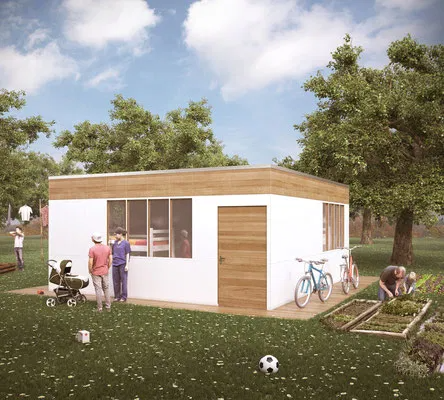
My calculations for material costs (2023) for a shell construction – including windows, doors, and an interior staircase – come to approximately €25,000.
Each component/element weighs about 35 kg. The modules are delivered prefabricated. The building modules are installed horizontally, efficiently, and quickly on the foundation slab, along the staggered substructure (or strip foundation). Just two workers could erect these walls without a crane or scaffolding.
How can these modules be manufactured by prefabricated house manufacturers as well as by carpentry/joinery firms?
Construction Description of Timber Wall Module according to DIN EN 1995-1-1 (Eurocode 5); from KI
The timber wall module is designed as a load-bearing, prefabricated timber panel element according to DIN EN 1995-1-1 (Eurocode 5) in conjunction with DIN EN 1990.
The sheathing on both sides consists of OSB/3 panels according to DIN EN 300 with dimensions of 205 × 62.5 cm and a thickness of 12 mm. The panels are butt-jointed and form the outer module surfaces. They do not perform any primary vertical or horizontal load-bearing functions, but rather serve to define the shape, provide diaphragm action, and structurally enclose the load-bearing structure.
The internal supporting frame consists of laminated hardwood according to DIN EN 14080. Three columns (posts) with a cross-section of 12 × 18 cm are arranged vertically. Two end posts, each 62.5 cm long, are located at the module ends and are designed as tongue-and-groove profiles. This design ensures a positive and force-fit connection between adjacent modules in the vertical assembly.
Another vertical post of the same dimensions is positioned centrally within the module. This post is clamped between the horizontal frame members and securely fastened using approved timber construction screws.
In the vertical module assembly, all vertical posts are stacked directly on top of each other, wood-to-wood. The connection is made using diagonally inserted, structurally designed timber screws in accordance with the ETA (European Technical Assessment). As concealed load-bearing components, the posts transfer the vertical loads from dead load, live loads, and, if applicable, wind loads.
The upper and lower horizontal frame structures are also made of laminated hardwood in accordance with DIN EN 14080. The frame members have a cross-section of 12 × 18 cm and a length of 205 cm. They are integrated into the modular system as tongue-and-groove connections, positioned between the OSB panels and additionally secured with timber screws. Direct load transfer to the OSB sheathing is structurally impossible.
The horizontal frame members act as beams in accordance with Eurocode 5 and are responsible for the horizontal load transfer and stiffening of the module.
The post-and-beam construction forms a closed, load-bearing structural system. The tongue-and-groove geometry of the edge posts and frame members ensures a positive interlocking of the modules, thus guaranteeing the load-bearing capacity of the modular assembly.
The modules are connected to each other in a wind-resistant manner by means of subsequent horizontal screw connections via the tongue and groove geometry – stable, reinforcing and removable if necessary (every 30 cm, fully threaded, 18 cm long, 6 mm Ø).
All cavities within the module between posts, beams, and sheathing are completely and void-free filled with mineral fiber mats in accordance with DIN EN 13162. The insulation fits precisely against the adjacent timber components and ensures complete filling of the module cross-section. It improves the thermal and acoustic insulation as well as the fire protection properties of the wall module and does not affect the load-bearing function of the timber structure.
(Further AI-generated submission issues available on request)
A module approved for construction in this manner allows for very rapid wall construction (with virtually concealed support posts, ring beams, and corner reinforcement: load paths via wood; for multi-story load-bearing capacity: ring beam per story ✔ wind-resistant ✔ windproof ✔ bracing ✔ re-disassemblable – 👉 a load-bearing, durable, industrially scalable, and structurally sound system).
The 80 tongue-and-groove elements can be handled by two people (without a construction crane or scaffolding).
Application includes:
Temporary and semi-permanent structures
Infill development & building extensions
Municipal, social, and commercial uses
Difference to conventional construction:
Drywall construction instead of wet construction
Demountable instead of demolition
Modularity instead of one-of-a-kind
Low weight instead of massive load-bearing capacity
Reuse instead of disposal
🧠 Summary (compliant with building regulations). The modular timber wall system achieves a fire resistance rating of at least 30 minutes (REI) through encapsulated load-bearing timber cross-sections, non-combustible insulation, interior fire-resistant gypsum plasterboard cladding, and fire-retardant joint design. 30). An increase to REI 60 is possible with additional internal cladding without changing the system.
Cables and other installations can be discreetly and fire-resistantly routed on the room side behind gypsum fiber strips (concealed as ceiling, corner, and baseboard moldings).
The corner joints could be additionally secured from the inside using 4x4 cm angle profiles with perforated holes (shelf uprights) and wood screws (16 cm long, 5 mm Ø).
The concept relies on easy disassembly and the ability to reassemble the numbered components exactly at another construction site.
📐 For corner joints: they are inserted in a staggered pattern (in combination with a half-length module). The corner post acts like a classic timber frame stud, but remains invisible and structurally integrates the ring beam (load distribution from the ceiling/roof connection), (➡️Material: Glued laminated timber (glulam) or structural timber (KVH) cross-section: 80 × 160 mm (1–2 stories))*. Result: continuous vertical load path, no OSB compressive load; posts rest wood-on-wood. Connection: 2–3 timber screws Ø8 × 160 mm, diagonally offset. Absorbs horizontal forces (wind), prevents buckling.
🔥 Fire protection concept – modular timber wall system.
1️⃣ Protection objective (clearly defined). The building should: have sufficient load-bearing capacity in case of fire, prevent fire spread within the wall, delay fire spread between rooms and stories, and provide occupants with sufficient escape time. ➡️ Target level: REI 30 (optional REI 60 with upgrade).
2️⃣ Wall construction – effective from a fire protection perspective 🔹 Base module (load-bearing). From outside to inside: 12 mm OSB3 contributes to the diaphragm effect, chars in case of fire, delaying the spread. OSB box frame + insulation. Insulation: Cellulose or mineral wool (A1/A2) prevents fire spread within the wall. 12 mm OSB3 (airtight). Interior cladding: Gypsum fiberboard ≥ 10 mm, screwed in place across its entire surface. ➡️ Result: Load-bearing wall REI 30 realistically achievable with two layers of gypsum fiberboard REI 60.
3️⃣ Load-bearing elements in case of fire 🔸 Integrated laminated timber posts (KVH / BSH / hardwood) cross-section 60 × 80 mm completely enclosed by: OSB insulation interior cladding. ➡️ Burn-off reserve present, wood chars in a controlled manner (~0.7 mm/min). Remaining cross-section remains load-bearing ≥ 30 min.
4️⃣ Insulation materials – Assessment: Insulation material fire class, rating cellulose (borated), B-s2,d0 very good. Mineral wool A1 optimal.
5️⃣ Module joints, plug-in system & fire barriers 🔥 Problem: Plug-in joints can allow fire spread. ✅ Solution: Mineral wool strips (20–30 mm) in horizontal module joints. Ceiling connections >> Interior joints: covered with gypsum fiberboard. Exterior joints: wood fiberboard/compression tape (non-combustible). ➡️ No vertical fire propagation possible.
6️⃣ Ceilings & floor transitions - structure (from bottom): 12.5 mm gypsum fiberboard, 15–18 mm OSB, ceiling joists with mineral wool. OSB/plank flooring on top. ➡️ Floor slab = fire barrier. Ring beam: completely encapsulated in OSB/gypsum, no exposed wood.
7️⃣ Installations: Routing of cables: in service channels or service layers, interior wall penetrations: with fire collars or mineral wool + fire-resistant sealant. ➡️ System remains demountable.
8️⃣ Escape & use (simplified concept). For small buildings (≤ 2 stories): One structural escape route is sufficient; windows can serve as a second escape route. Smoke detectors are required in all habitable rooms.
9️⃣ Building Class – Realistic Classification (D/A). With the above construction: Building Class 1–2: no problem. Class 3: realistic with REI 30. Class 4: REI 60 + detailed verification required. ➡️ The system is not exotic, but typical for timber construction. 🔧 Minimal upgrade for REI 60 (optional), interior: 2 × 12.5 mm gypsum fiberboard. Posts: cross-section +20 mm. Joints: additional mineral wool battens. ➡️ Minimal additional costs, significant safety gain.
Continuing with the example: A simple wooden stringer staircase leads to the sleeping area on the upper floor – with a wardrobe storage area and a 7 m² conservatory.
Three horizontal window elements (2 x 0.6 m), each integrated into the module, and the patio door (1.6 x 1.8 m) provide ample natural light to both interior spaces (automatic ventilation**).
On the outside, a reed mat covering is also planned as a curtain wall system, which will be attached to counter battens. The mats will first be spray-impregnated with water glass on both sides to protect them against weathering and flammability. In combination with planted evergreen ivy cuttings, a shading and rear-ventilated green façade quickly develops, extending upwards around the base of the house. As a supporting cold and heat regulator, aluminium foil could be applied to the modules – alternately inside and outside, i.e. on about half of the surface – without any condensation problems. Green façade, wooden wall, integrated mineral wool and aluminium foil provide good insulation against summer heat radiation (without the need for technical cooling) – as well as keeping the building warm in winter.
Among other things, the following are addressed:
+ Temporary and semi-permanent structures
+ Redensification and vertical expansion
+ Municipal, social and commercial uses
Difference from conventional construction:
+ Dry construction instead of wet construction
+ Dismantling instead of demolition
+ Modularity instead of one-off designs
+ Low weight instead of heavy loads
+ Reuse instead of disposal
Multi-storey construction:
Criterion Assessment
1 storey no problem
2 storeys very feasible
3 storeys possible with ring beams
Wind zone 2–3 manageable
Dismantling preserved
Series production excellent
❗ Absolutely necessary:
Ring beams per storey
Load transfer only via wooden posts
OSB = disc, not support
2️⃣ Ring beams – integration into the modular system
Integration into the modules/Variant A – surface-mounted (easiest)
Ring beam rests on the integrated support posts
Posts extend through the entire storey
Connection:
2 × fully threaded screws Ø8 × 200 mm per post
Screwed in diagonally from above
Variant B – recessed (cleanest solution)
Ring beam lies in a:
40–50 mm deep recess in the modules
OSB covers it on the outside
ceiling connection later on the inside
➡️ completely invisible/ceiling connection
Ceiling beams or CLT panels:
rest on the ring beam
screwed together in a force-fit manner
the next module floor is placed on the ring beam again
Energy from: A 5 m² vacuum tube collector is mounted against the south wall. A 500-liter buffer tank located above it heats the system.
A copper pipe is installed as a baseboard. The storage tank also supplies hot water to the washing machine and dishwasher.
The 50 m² (including overhang) pitched roof can be fully covered with ThinFilm membranes**** and/or PVT panels (are hybrid solar modules that generate both electricity and heat by combining solar cells with a heat exchanger). In conjunction with PV batteries, it can also power a split-system heat pump/air conditioning unit – such as the award-winning Dimstal eco-smart Inverter – QuickConnect.
Rainwater from the roof is collected in two 200-liter barrels and used to irrigate the vegetable garden.
Target groups are: (implicit/explicit)
for DIY builders
for temporary/mobile architecture
for building extensions
for public/social infrastructure
*Kronply-OSB/3-EN300, for example, offers panels that meet the criteria for use in fire-resistant constructions according to DIN 4102-4, certified to fire resistance class F30.
**Automatic room ventilation with heat recovery:** A simple, automatic ventilation system with heat recovery ensures continuous air exchange. It operates with low energy consumption, requires minimal maintenance, and is fully integrated into the interior ceiling channels. A 5-meter-long, 100 mm diameter aluminum flexible duct, concealed behind the ceiling channel, is connected to an interval-controlled fan installed in a corresponding wall opening. The duct ensures good circulation of the stale warm air and transfers a significant temperature equalization to the fresh air flowing in through the rest of the channel. From the branch point of the 100 mm inlet, the air is directed vertically downwards for 2.3 meters as a corner channel. The negative pressure created in the room by the 150 mm exhaust fan causes fresh air to flow in automatically at the open end of the corner channel. The channel itself, made of rigid cardboard, also transfers a certain degree of temperature equalization to the incoming fresh air due to the warm room air directly adjacent to it.
*** PV films are produced by companies such as: ARMOR solar power films, Heliatek®, Flisom, Alwitra-Evalon cSi®, FirstSolar®, and Nanosolar®.
"The described approach is a modular, evolvable prototype that has been tested in certain aspects but still requires formal approval as a complete system."
AI-optimized, Dec. 2025
_________________ Source IPCC: Cement production emits more CO² than air traffic and shipping combined!
It is therefore imperative to reduce CO2-polluting cement production and the ecological consequences of sand mining. After all, the food chain of marine life begins with micro-diversity, which is primarily based on sandy sea beds!
May countless of these structures be built from renewable trees. Even if not every tree is nature and forest is not the same as forest.
SEE: YOUTUBE: PETER WOHLLEBEN - THE SECRET LIFE OF TREES.
© by Thalhammer Michael - Vienna on 02.09..2022
===============
This construction method is also well suited for migration needs and reconstruction after war damage!
The consequences of war, flight and displacement are increasing worldwide. Many cities are uninhabitable or uninhabitable and legions of people have no or only miserable living space. However, the usual containers and tents - for people - are not suitable accommodation in the heat or cold; they are also bulky to transport.
Whether as a school, ambulance, office, shop or housing requirement - the construction method described above can be used to save space, especially with storeys. These elements can be set up by 2 - 3 people using N/F plug-in connections to suit the respective room utilisation.
To counteract short-wave solar heating, it is particularly advisable - especially in hot regions - to cover the building with reed mats and shade it with ivy.
Stackable wall modules are a mobile and frequently deployable solution for almost any purpose.
 The drawing shows an example of many possibilities.
Here as a multi-purpose building with variable room partitioning. This approach requires only simple hand tools for its construction (as well as for its dismantling for reuse).
These living spaces are based on a foundation-free 120 m² mansard roof, with a central 60 m² communal space arranged around the main room. The total interior space in this example covers 120 m². 63 m² are added as floor areas - divided between the 18 units.
This approach would be suitable for support communities whose aim is to offer refuge and encounters for people in crisis from different walks of life.
The most essential, applicable house rules would be: # ... to respect each other. # ... be there for each other as a "small family" and stick together. # ... to help organise the daily structure and group activities as much as possible.
In this example, the central 60 m² of the NurDach serves as a work and recreation room. Small products can be made there in co-operation or various services can be offered.
Smoking and drinking are only permitted outside the building!
Two of the rooms are reserved as an office (or night-time standby room) and as storage - this would result in 18 units of equal size.
Each of the 16 private rooms has 4 m² of living space measuring 3 m x 1.23 m and a room height of 2.5 m and a small window to the day room. Above this is a 3.5 m² attic room, which is accessible via a folding attic staircase.
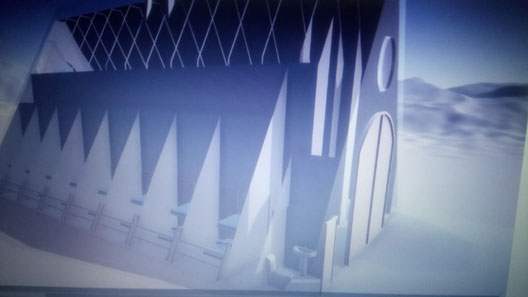
All sliding doors to the living area can be locked by their respective occupants. In addition to the bed equipment, it also has a wardrobe, folding table, folding chair, a mini-eco-heater, LED lamps and DAB radio with headphones - as well as an attachable extra bed for children who may also move in; and adjustable ventilation.
Residents can keep their sleeping hours around the clock, but there is a general night's rest from 11 pm to 7 am.
The two WCs located in the canopy, the washbasin and the shower have their 12V LED lighting switched by motion sensors.
The shower water is regulated to be drawn every three minutes so that there is enough hot water for everyone. There is also a washing machine and three fridges for residents to use.
In cold weather, the 10 x 6 metre central room of the "NurDach" also provides a place for children and their parents to play and snuggle up. Screens form a partition from the rest of the space, which all residents can use for their various activities.
The kitchen, dining area and sanitary facilities would be located outside under one roof.
The panels hanging down at the outer edge are rolled up in strong winds. These mats are protected against fire and weathering with a coat of water glass.
There is also a children's play tower with 2 swings, sandpit and slide fenced in by Immergrün under this canopy.
The house and porch would also be surrounded by a hedge, raised beds and berry bushes.
Two 1000 litre hot water tanks are located centrally in the porch - they are connected to the hot water collectors on the south-facing roof. This space is also used by a PV module to supply the 12V consumers with electricity.
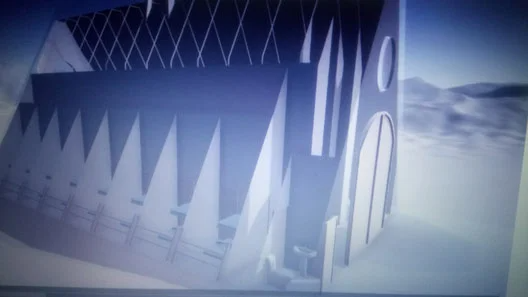
Leisure activities include badminton, table tennis and a bookshelf as well as sewing, pottery, language courses, music, painting, dance, gymnastics and more. The carers offer a varied, colourful daily structure - according to their own talents and focus. Whether it's an excursion, singing, meditation or a basic PC course - there are always encounters and useful things on the programme.
By coming together on a daily basis to work and spend leisure time together, there are also interdenominational and non-political human conversations.
The project costs a total of around €50,000 per unit.
Most of the goods would come from DIY stores, which would then also appear as the main donors.
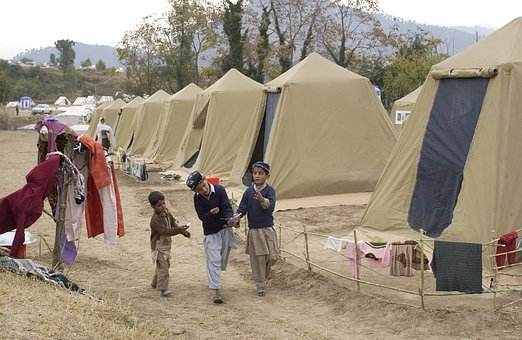
More you see in the older 3-D-Video and to www.vimeo.com/293395008
ON THE WAY TO THE LIGHT LEAVE NO ONE BEHIND ! Peter Rosegger
- -------------===========------------- -
Solar thermal energy, for example, is a very important building block here, along with other aspects: "Why generate electricity first and then heat from it? That's what solar thermal energy is for." Dr Gerhard Rimpler heard this question and the response to it quite frequently almost ten years ago. However, with the unusual idea of using photovoltaic systems to produce hot water, his company my-PV initiated nothing less than a paradigm shift in solar heat generation. Since then, the guiding principle of "cables instead of pipes" has really shaken up the solar market. The "revolution in solar thermal energy" began in 2014 with the ELWA product! https://www.my-pv.com/de/news/photovoltaikwaerme-vs-solarthermie-kosten-und-flaechenvergleich/ and too www.citybox-solar.com .
According to solar house pioneer Josef Jenni, " ... hot water panels are the gentlest, most environmentally friendly and most efficient technology. "Heat is generated as heat, stored as heat and consumed as heat". Solar thermal energy is collected close to where the heat is needed, for example on the roof of buildings. This heat can also be stored on site relatively easily. In addition, the use of solar thermal energy saves a lot of electricity. The energy transition would therefore primarily be a "heat transition", see www.sonnenhaus-institut.de.
In order to support the 1.5° climate target, the spatial planning authority must take more effective action against further urban sprawl! In addition, sustainable, self-sufficient energy supply must immediately become a new, mandatory building standard.
In general, buildings in rural areas should not be less than 150 m² and should not be less than three storeys high. It would also be right to demand that the "global players" in the retail sector, who have been reclassified as building land and account for a relatively large proportion of soil sealing, and who only build at ground level but on a large scale under a handful of brand or company names on countless village outskirts, be subject to restrictions. They should subsequently add 1 - 3 storeys and a vertical roof garden with generally useful living space. In addition, the car park areas previously sealed with asphalt were to be replaced with functional paving to allow rainwater to be absorbed.
With the costs of building sand and energy sure to continue to rise, there will inevitably be a change in our construction practices. A switch from cement, sand and reinforcing steel to, for example, OSB with EPS insulation - as well as applied PV film façades - would be sustainable, future-proof and therefore desirable.
The installation of vertical wind turbines (Bladeless-Vortex), which have not yet been able to gain acceptance - probably due to the current wind turbine lobby - would also generate energy. The same applies to PV solar films, which should be given preference over heavy silicon panels in aluminium frames.
_________________
These approaches could and should also be adopted by the construction industry as well as by the UNHCR, FAO or UNIDO for further implementation.
~~~~~~~~
~~~~~
~~
Due to the significant environmental problems associated with cement production and the extraction of construction sand, entirely new approaches could be taken in the construction sector. My approach: sustainable building components in an affordable modular design, ➡️multi-story, scalable, contributes to this.
The Timber Wall Construction is suitable for everything from tiny houses to multi-story buildings. The low module weight makes it ideal for adding stories to existing buildings. Thanks to its high inherent stability and dry construction method, cost-effective buildings can be erected quickly.
With proper installation, a very long service life can be expected. At the end of its lifespan, all building elements are sorted and ready for reuse. The concept is conceived as an open, evolving building system that represents a future-proof alternative to cement- and energy-intensive construction methods.
This modular plug-in system could generate secure profits everywhere, especially when meeting customer requirements in the field of industrial and standardised series production.
The system targets markets with:
rising construction costs
resource scarcity (sand, cement, energy)
and a need for quickly erected, reversible buildings.
The modular building system concept is based on commercially available materials and established construction principles. The degree of innovation lies not in individual components, but in their systemic combination, disassembly, and scalability. Depending on the implementation, this could lead to a product portfolio, a licensing model, or a project-based business.
In this concept, the stackable sandwich wall modules represent a mobile and frequently deployable option. This example corresponds to my vision of a garden house, with a 35 m² footprint and a height of 5 m. The prefabricated modules can be manufactured in the medium term, joined together on the building site using a tongue-and-groove quick-assembly system, and lifted into place together with the upper storey.
My calculations for material costs (2023) for a shell construction – including windows, doors, and an interior staircase – come to approximately €25,000.
Each component/element weighs about 35 kg. The modules are delivered prefabricated. The building modules are installed horizontally, efficiently, and quickly on the foundation slab, along the staggered substructure (or strip foundation). Just two workers could erect these walls without a crane or scaffolding.
How can these modules be manufactured by prefabricated house manufacturers as well as by carpentry/joinery firms?
Construction Description of Timber Wall Module according to DIN EN 1995-1-1 (Eurocode 5); from KI
The timber wall module is designed as a load-bearing, prefabricated timber panel element according to DIN EN 1995-1-1 (Eurocode 5) in conjunction with DIN EN 1990.
The sheathing on both sides consists of OSB/3 panels according to DIN EN 300 with dimensions of 205 × 62.5 cm and a thickness of 12 mm. The panels are butt-jointed and form the outer module surfaces. They do not perform any primary vertical or horizontal load-bearing functions, but rather serve to define the shape, provide diaphragm action, and structurally enclose the load-bearing structure.
The internal supporting frame consists of laminated hardwood according to DIN EN 14080. Three columns (posts) with a cross-section of 12 × 18 cm are arranged vertically. Two end posts, each 62.5 cm long, are located at the module ends and are designed as tongue-and-groove profiles. This design ensures a positive and force-fit connection between adjacent modules in the vertical assembly.
Another vertical post of the same dimensions is positioned centrally within the module. This post is clamped between the horizontal frame members and securely fastened using approved timber construction screws.
In the vertical module assembly, all vertical posts are stacked directly on top of each other, wood-to-wood. The connection is made using diagonally inserted, structurally designed timber screws in accordance with the ETA (European Technical Assessment). As concealed load-bearing components, the posts transfer the vertical loads from dead load, live loads, and, if applicable, wind loads.
The upper and lower horizontal frame structures are also made of laminated hardwood in accordance with DIN EN 14080. The frame members have a cross-section of 12 × 18 cm and a length of 205 cm. They are integrated into the modular system as tongue-and-groove connections, positioned between the OSB panels and additionally secured with timber screws. Direct load transfer to the OSB sheathing is structurally impossible.
The horizontal frame members act as beams in accordance with Eurocode 5 and are responsible for the horizontal load transfer and stiffening of the module.
The post-and-beam construction forms a closed, load-bearing structural system. The tongue-and-groove geometry of the edge posts and frame members ensures a positive interlocking of the modules, thus guaranteeing the load-bearing capacity of the modular assembly.
The modules are connected to each other in a wind-resistant manner by means of subsequent horizontal screw connections via the tongue and groove geometry – stable, reinforcing and removable if necessary (every 30 cm, fully threaded, 18 cm long, 6 mm Ø).
All cavities within the module between posts, beams, and sheathing are completely and void-free filled with mineral fiber mats in accordance with DIN EN 13162. The insulation fits precisely against the adjacent timber components and ensures complete filling of the module cross-section. It improves the thermal and acoustic insulation as well as the fire protection properties of the wall module and does not affect the load-bearing function of the timber structure.
(Further AI-generated submission issues available on request)
A module approved for construction in this manner allows for very rapid wall construction (with virtually concealed support posts, ring beams, and corner reinforcement: load paths via wood; for multi-story load-bearing capacity: ring beam per story ✔ wind-resistant ✔ windproof ✔ bracing ✔ re-disassemblable – 👉 a load-bearing, durable, industrially scalable, and structurally sound system).
The 80 tongue-and-groove elements can be handled by two people (without a construction crane or scaffolding).
Application includes:
Temporary and semi-permanent structures
Infill development & building extensions
Municipal, social, and commercial uses
Difference to conventional construction:
Drywall construction instead of wet construction
Demountable instead of demolition
Modularity instead of one-of-a-kind
Low weight instead of massive load-bearing capacity
Reuse instead of disposal
🧠 Summary (compliant with building regulations). The modular timber wall system achieves a fire resistance rating of at least 30 minutes (REI) through encapsulated load-bearing timber cross-sections, non-combustible insulation, interior fire-resistant gypsum plasterboard cladding, and fire-retardant joint design. 30). An increase to REI 60 is possible with additional internal cladding without changing the system.
Cables and other installations can be discreetly and fire-resistantly routed on the room side behind gypsum fiber strips (concealed as ceiling, corner, and baseboard moldings).
The corner joints could be additionally secured from the inside using 4x4 cm angle profiles with perforated holes (shelf uprights) and wood screws (16 cm long, 5 mm Ø).
The concept relies on easy disassembly and the ability to reassemble the numbered components exactly at another construction site.
📐 For corner joints: they are inserted in a staggered pattern (in combination with a half-length module). The corner post acts like a classic timber frame stud, but remains invisible and structurally integrates the ring beam (load distribution from the ceiling/roof connection), (➡️Material: Glued laminated timber (glulam) or structural timber (KVH) cross-section: 80 × 160 mm (1–2 stories))*. Result: continuous vertical load path, no OSB compressive load; posts rest wood-on-wood. Connection: 2–3 timber screws Ø8 × 160 mm, diagonally offset. Absorbs horizontal forces (wind), prevents buckling.
🔥 Fire protection concept – modular timber wall system.
1️⃣ Protection objective (clearly defined). The building should: have sufficient load-bearing capacity in case of fire, prevent fire spread within the wall, delay fire spread between rooms and stories, and provide occupants with sufficient escape time. ➡️ Target level: REI 30 (optional REI 60 with upgrade).
2️⃣ Wall construction – effective from a fire protection perspective 🔹 Base module (load-bearing). From outside to inside: 12 mm OSB3 contributes to the diaphragm effect, chars in case of fire, delaying the spread. OSB box frame + insulation. Insulation: Cellulose or mineral wool (A1/A2) prevents fire spread within the wall. 12 mm OSB3 (airtight). Interior cladding: Gypsum fiberboard ≥ 10 mm, screwed in place across its entire surface. ➡️ Result: Load-bearing wall REI 30 realistically achievable with two layers of gypsum fiberboard REI 60.
3️⃣ Load-bearing elements in case of fire 🔸 Integrated laminated timber posts (KVH / BSH / hardwood) cross-section 60 × 80 mm completely enclosed by: OSB insulation interior cladding. ➡️ Burn-off reserve present, wood chars in a controlled manner (~0.7 mm/min). Remaining cross-section remains load-bearing ≥ 30 min.
4️⃣ Insulation materials – Assessment: Insulation material fire class, rating cellulose (borated), B-s2,d0 very good. Mineral wool A1 optimal.
5️⃣ Module joints, plug-in system & fire barriers 🔥 Problem: Plug-in joints can allow fire spread. ✅ Solution: Mineral wool strips (20–30 mm) in horizontal module joints. Ceiling connections >> Interior joints: covered with gypsum fiberboard. Exterior joints: wood fiberboard/compression tape (non-combustible). ➡️ No vertical fire propagation possible.
6️⃣ Ceilings & floor transitions - structure (from bottom): 12.5 mm gypsum fiberboard, 15–18 mm OSB, ceiling joists with mineral wool. OSB/plank flooring on top. ➡️ Floor slab = fire barrier. Ring beam: completely encapsulated in OSB/gypsum, no exposed wood.
7️⃣ Installations: Routing of cables: in service channels or service layers, interior wall penetrations: with fire collars or mineral wool + fire-resistant sealant. ➡️ System remains demountable.
8️⃣ Escape & use (simplified concept). For small buildings (≤ 2 stories): One structural escape route is sufficient; windows can serve as a second escape route. Smoke detectors are required in all habitable rooms.
9️⃣ Building Class – Realistic Classification (D/A). With the above construction: Building Class 1–2: no problem. Class 3: realistic with REI 30. Class 4: REI 60 + detailed verification required. ➡️ The system is not exotic, but typical for timber construction. 🔧 Minimal upgrade for REI 60 (optional), interior: 2 × 12.5 mm gypsum fiberboard. Posts: cross-section +20 mm. Joints: additional mineral wool battens. ➡️ Minimal additional costs, significant safety gain.
Continuing with the example: A simple wooden stringer staircase leads to the sleeping area on the upper floor – with a wardrobe storage area and a 7 m² conservatory.
Three horizontal window elements (2 x 0.6 m), each integrated into the module, and the patio door (1.6 x 1.8 m) provide ample natural light to both interior spaces (automatic ventilation**).
On the outside, a reed mat covering is also planned as a curtain wall system, which will be attached to counter battens. The mats will first be spray-impregnated with water glass on both sides to protect them against weathering and flammability. In combination with planted evergreen ivy cuttings, a shading and rear-ventilated green façade quickly develops, extending upwards around the base of the house. As a supporting cold and heat regulator, aluminium foil could be applied to the modules – alternately inside and outside, i.e. on about half of the surface – without any condensation problems. Green façade, wooden wall, integrated mineral wool and aluminium foil provide good insulation against summer heat radiation (without the need for technical cooling) – as well as keeping the building warm in winter.
Among other things, the following are addressed:
+ Temporary and semi-permanent structures
+ Redensification and vertical expansion
+ Municipal, social and commercial uses
Difference from conventional construction:
+ Dry construction instead of wet construction
+ Dismantling instead of demolition
+ Modularity instead of one-off designs
+ Low weight instead of heavy loads
+ Reuse instead of disposal
Multi-storey construction:
Criterion Assessment
1 storey no problem
2 storeys very feasible
3 storeys possible with ring beams
Wind zone 2–3 manageable
Dismantling preserved
Series production excellent
❗ Absolutely necessary:
Ring beams per storey
Load transfer only via wooden posts
OSB = disc, not support
2️⃣ Ring beams – integration into the modular system
Integration into the modules/Variant A – surface-mounted (easiest)
Ring beam rests on the integrated support posts
Posts extend through the entire storey
Connection:
2 × fully threaded screws Ø8 × 200 mm per post
Screwed in diagonally from above
Variant B – recessed (cleanest solution)
Ring beam lies in a:
40–50 mm deep recess in the modules
OSB covers it on the outside
ceiling connection later on the inside
➡️ completely invisible/ceiling connection
Ceiling beams or CLT panels:
rest on the ring beam
screwed together in a force-fit manner
the next module floor is placed on the ring beam again
Energy from: A 5 m² vacuum tube collector is mounted against the south wall. A 500-liter buffer tank located above it heats the system.
A copper pipe is installed as a baseboard. The storage tank also supplies hot water to the washing machine and dishwasher.
The 50 m² (including overhang) pitched roof can be fully covered with ThinFilm membranes**** and/or PVT panels (are hybrid solar modules that generate both electricity and heat by combining solar cells with a heat exchanger). In conjunction with PV batteries, it can also power a split-system heat pump/air conditioning unit – such as the award-winning Dimstal eco-smart Inverter – QuickConnect.
Rainwater from the roof is collected in two 200-liter barrels and used to irrigate the vegetable garden.
Target groups are: (implicit/explicit)
for DIY builders
for temporary/mobile architecture
for building extensions
for public/social infrastructure
*Kronply-OSB/3-EN300, for example, offers panels that meet the criteria for use in fire-resistant constructions according to DIN 4102-4, certified to fire resistance class F30.
**Automatic room ventilation with heat recovery:** A simple, automatic ventilation system with heat recovery ensures continuous air exchange. It operates with low energy consumption, requires minimal maintenance, and is fully integrated into the interior ceiling channels. A 5-meter-long, 100 mm diameter aluminum flexible duct, concealed behind the ceiling channel, is connected to an interval-controlled fan installed in a corresponding wall opening. The duct ensures good circulation of the stale warm air and transfers a significant temperature equalization to the fresh air flowing in through the rest of the channel. From the branch point of the 100 mm inlet, the air is directed vertically downwards for 2.3 meters as a corner channel. The negative pressure created in the room by the 150 mm exhaust fan causes fresh air to flow in automatically at the open end of the corner channel. The channel itself, made of rigid cardboard, also transfers a certain degree of temperature equalization to the incoming fresh air due to the warm room air directly adjacent to it.
*** PV films are produced by companies such as: ARMOR solar power films, Heliatek®, Flisom, Alwitra-Evalon cSi®, FirstSolar®, and Nanosolar®.
"The described approach is a modular, evolvable prototype that has been tested in certain aspects but still requires formal approval as a complete system."
AI-optimized, Dec. 2025
_________________
Source IPCC: Cement production emits more CO² than air traffic and shipping combined!It is therefore imperative to reduce CO2-polluting cement production and the ecological consequences of sand mining. After all, the food chain of marine life begins with micro-diversity, which is primarily based on sandy sea beds!
May countless of these structures be built from renewable trees. Even if not every tree is nature and forest is not the same as forest.
SEE: YOUTUBE: PETER WOHLLEBEN - THE SECRET LIFE OF TREES.
© by Thalhammer Michael - Vienna on 02.09..2022
===============
This construction method is also well suited for migration needs and reconstruction after war damage!
The consequences of war, flight and displacement are increasing worldwide. Many cities are uninhabitable or uninhabitable and legions of people have no or only miserable living space. However, the usual containers and tents - for people - are not suitable accommodation in the heat or cold; they are also bulky to transport.
Whether as a school, ambulance, office, shop or housing requirement - the construction method described above can be used to save space, especially with storeys. These elements can be set up by 2 - 3 people using N/F plug-in connections to suit the respective room utilisation.
To counteract short-wave solar heating, it is particularly advisable - especially in hot regions - to cover the building with reed mats and shade it with ivy.
Stackable wall modules are a mobile and frequently deployable solution for almost any purpose.
The drawing shows an example of many possibilities.Here as a multi-purpose building with variable room partitioning. This approach requires only simple hand tools for its construction (as well as for its dismantling for reuse).
These living spaces are based on a foundation-free 120 m² mansard roof, with a central 60 m² communal space arranged around the main room. The total interior space in this example covers 120 m². 63 m² are added as floor areas - divided between the 18 units.
This approach would be suitable for support communities whose aim is to offer refuge and encounters for people in crisis from different walks of life.
The most essential, applicable house rules would be: # ... to respect each other. # ... be there for each other as a "small family" and stick together. # ... to help organise the daily structure and group activities as much as possible.
In this example, the central 60 m² of the NurDach serves as a work and recreation room. Small products can be made there in co-operation or various services can be offered.
Smoking and drinking are only permitted outside the building!
Two of the rooms are reserved as an office (or night-time standby room) and as storage - this would result in 18 units of equal size.
Each of the 16 private rooms has 4 m² of living space measuring 3 m x 1.23 m and a room height of 2.5 m and a small window to the day room. Above this is a 3.5 m² attic room, which is accessible via a folding attic staircase.
All sliding doors to the living area can be locked by their respective occupants. In addition to the bed equipment, it also has a wardrobe, folding table, folding chair, a mini-eco-heater, LED lamps and DAB radio with headphones - as well as an attachable extra bed for children who may also move in; and adjustable ventilation.
Residents can keep their sleeping hours around the clock, but there is a general night's rest from 11 pm to 7 am.
The two WCs located in the canopy, the washbasin and the shower have their 12V LED lighting switched by motion sensors.
The shower water is regulated to be drawn every three minutes so that there is enough hot water for everyone. There is also a washing machine and three fridges for residents to use.
In cold weather, the 10 x 6 metre central room of the "NurDach" also provides a place for children and their parents to play and snuggle up. Screens form a partition from the rest of the space, which all residents can use for their various activities.
The kitchen, dining area and sanitary facilities would be located outside under one roof.
The panels hanging down at the outer edge are rolled up in strong winds. These mats are protected against fire and weathering with a coat of water glass.
There is also a children's play tower with 2 swings, sandpit and slide fenced in by Immergrün under this canopy.
The house and porch would also be surrounded by a hedge, raised beds and berry bushes.
Two 1000 litre hot water tanks are located centrally in the porch - they are connected to the hot water collectors on the south-facing roof. This space is also used by a PV module to supply the 12V consumers with electricity.
Leisure activities include badminton, table tennis and a bookshelf as well as sewing, pottery, language courses, music, painting, dance, gymnastics and more. The carers offer a varied, colourful daily structure - according to their own talents and focus. Whether it's an excursion, singing, meditation or a basic PC course - there are always encounters and useful things on the programme.
By coming together on a daily basis to work and spend leisure time together, there are also interdenominational and non-political human conversations.
The project costs a total of around €50,000 per unit.
Most of the goods would come from DIY stores, which would then also appear as the main donors.
More you see in the older 3-D-Video and to www.vimeo.com/293395008
ON THE WAY TO THE LIGHT LEAVE NO ONE BEHIND ! Peter Rosegger
- -------------===========------------- -
Solar thermal energy, for example, is a very important building block here, along with other aspects: "Why generate electricity first and then heat from it? That's what solar thermal energy is for." Dr Gerhard Rimpler heard this question and the response to it quite frequently almost ten years ago. However, with the unusual idea of using photovoltaic systems to produce hot water, his company my-PV initiated nothing less than a paradigm shift in solar heat generation. Since then, the guiding principle of "cables instead of pipes" has really shaken up the solar market. The "revolution in solar thermal energy" began in 2014 with the ELWA product! https://www.my-pv.com/de/news/photovoltaikwaerme-vs-solarthermie-kosten-und-flaechenvergleich/ and too www.citybox-solar.com .
According to solar house pioneer Josef Jenni, " ... hot water panels are the gentlest, most environmentally friendly and most efficient technology. "Heat is generated as heat, stored as heat and consumed as heat". Solar thermal energy is collected close to where the heat is needed, for example on the roof of buildings. This heat can also be stored on site relatively easily. In addition, the use of solar thermal energy saves a lot of electricity. The energy transition would therefore primarily be a "heat transition", see www.sonnenhaus-institut.de.
In order to support the 1.5° climate target, the spatial planning authority must take more effective action against further urban sprawl! In addition, sustainable, self-sufficient energy supply must immediately become a new, mandatory building standard.
In general, buildings in rural areas should not be less than 150 m² and should not be less than three storeys high. It would also be right to demand that the "global players" in the retail sector, who have been reclassified as building land and account for a relatively large proportion of soil sealing, and who only build at ground level but on a large scale under a handful of brand or company names on countless village outskirts, be subject to restrictions. They should subsequently add 1 - 3 storeys and a vertical roof garden with generally useful living space. In addition, the car park areas previously sealed with asphalt were to be replaced with functional paving to allow rainwater to be absorbed.
With the costs of building sand and energy sure to continue to rise, there will inevitably be a change in our construction practices. A switch from cement, sand and reinforcing steel to, for example, OSB with EPS insulation - as well as applied PV film façades - would be sustainable, future-proof and therefore desirable.
The installation of vertical wind turbines (Bladeless-Vortex), which have not yet been able to gain acceptance - probably due to the current wind turbine lobby - would also generate energy. The same applies to PV solar films, which should be given preference over heavy silicon panels in aluminium frames.
_________________
These approaches could and should also be adopted by the construction industry as well as by the UNHCR, FAO or UNIDO for further implementation.
~~~~~~~~
~~~~~
~~